

Supplier segmentation refers to the process of differentiating the supply base in terms of their impact on your organization and the risks they pose. In doing so, procurement professionals can determine how much engagement different suppliers require, and effectively allocate their limited resources.
When it comes to managing your personal relationships, it’s likely that you practice segmentation on a daily basis. It’s simply not feasible to invest an equal amount of time in each and every person that crosses your path.
You may have some low-maintenance friends who you only check in with a couple of times a year, while other people in your life require a great deal more focus and attention.
Whether it’s a friend, brother, grandparent, doctor, yoga instructor, taxi driver, or manager, you’re forever weighing how best to divide your time. Who requires your attention the most? Are there some relationships you value more than others? Which of these relationships will continue to function and flourish with minimal intervention?
Supplier segmentation is essentially the same concept.
The bigger your supply base, the more important it is to identify your critical suppliers. This enables procurement professionals to:
In the past, procurement professionals would typically assign a status to their suppliers based exclusively on their level of spend, but the criteria by which organizations measure supplier risk and impact is evolving rapidly.
Today the most common method for supplier segmentation is the Kraljic Matrix, an approach developed by Peter Kraljic in 1983. Procurement professionals can use this 2 x 2 matrix to plot suppliers into one of four quadrants, as shown in the image below.
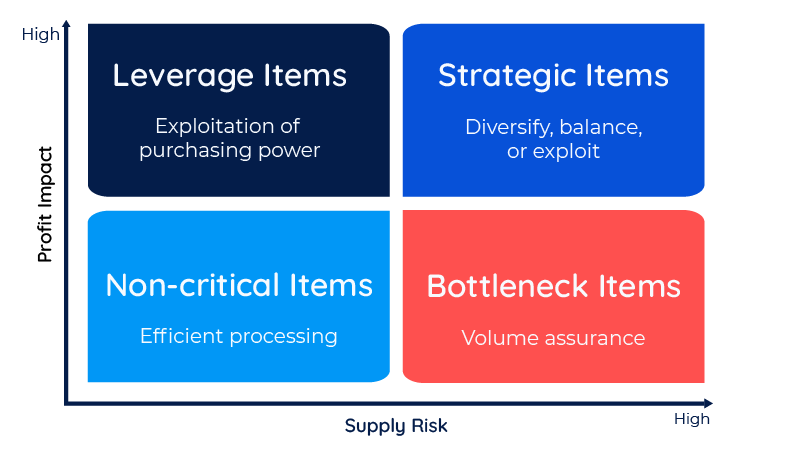
The first step in the Kraljic segmentation method is to define the factors that comprise risk and impact for your organization. This will vary across organizations and categories but might include the following:
Assign a weight for each of these factors before computing scores for your suppliers and plotting them onto one of the four dimensions of the Kraljic matrix.
The strategic items quadrant represents high-risk suppliers that deliver critical products and services for your organization. Without them, your supply chain could face severe disruption, which means they require the most intensive SRM.
Suppliers who fall into this quadrant are equally critical to your organization, but they present a much lower risk. Perhaps the products and services they provide are easily obtainable elsewhere, or the supplier is capable of delivering to a high-standard with or without your input.
Bottleneck items will largely consist of tail-end suppliers. They’re high-risk but deliver little-to-no value for your organization. It might be worthwhile to consolidate this section of your supplier base, rather than investing in more strategic SRM. However, you’ll need to bear in mind that several of these suppliers will be single-source, and for the time being, your organization is reliant on their services.
Some tail-end spend will also be represented in the non-critical items quadrant. These suppliers provide your organization with low-value, low-impact items with negligible risk. Your supply chain won’t be significantly disrupted should you lose these suppliers. Suppliers in this quadrant require the least effort to manage.
Supplier segmentation is a useful stepping stone on procurement’s journey to implementing an effective preferred supplier program with those falling into the top half of the quadrant being those most likely to become a preferred supplier.
Save time, effort, and money by outsourcing your non-critical and bottleneck spend to Una, and free up your procurement team to focus on your SRM program. Get in touch to learn more.

